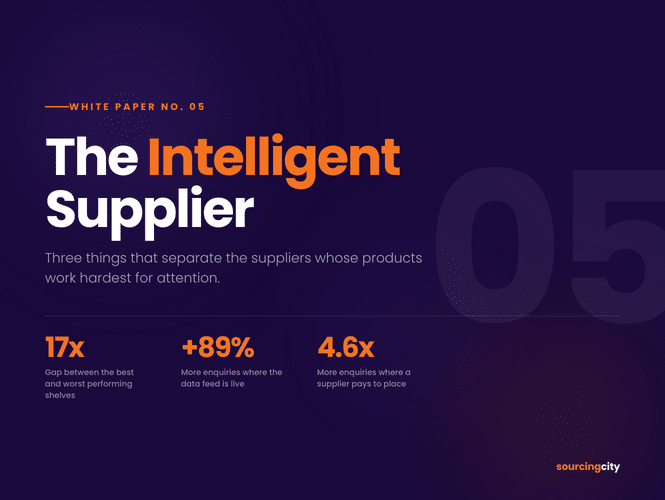
Industry Research · White Paper No. 05
Sourcing City recorded 674,584 Click Through Enquiries in 2025. Every one of them was a professional distributor, in front of a real customer, choosing one product over several others on screen. The Intelligent Supplier analyses those decisions to answer a question most suppliers have never been able to measure: how hard is every product in your range actually working?
The paper looks exclusively at the 302 suppliers actively trading on the platform. Every one of them has already decided this market is worth investing in, which makes the differences between them more interesting than any comparison with suppliers who are not here at all.
Shelf space does not decide who gets found
At market level, attention looks entirely predictable. The fifty largest suppliers hold 73.3 per cent of all products listed and take 73.2 per cent of all enquiries. Collectively, they get what their shelf space would suggest.
Look at them individually and that falls apart. Measuring each supplier’s share of enquiries against its own share of products, the score runs from 0.33 to 5.51. The strongest earns more than five times what its product count would predict. The weakest earns a third. Twenty two of the fifty earn more than their shelf predicts. Thirteen earn less. The average describes almost nobody.
|
The question the paper exists to answer
Same market. Same platform. Same level of commitment. Wildly different results. Something other than the number of products listed is deciding who gets found.
|
Three marks of an intelligent supplier
The paper identifies three things that separate the suppliers whose products work hardest, all of them measurable and all of them decisions a supplier already makes without necessarily knowing it.
|
1
|
They know which products are actually working
Among suppliers listing fewer than 25 products, the median is 20.3 enquiries per product. Among those listing 500 to 2,000, it is 4.0. Five times the attention per product. The paper is careful to say this is not an argument for smaller ranges: a large range serves buyers a small one cannot, and the volume it generates is real. Breadth buys volume, focus buys efficiency, and very few suppliers have measured which one they are getting.
|
|
2
|
They treat product data as an asset, not as admin
Comparing suppliers of similar range size, those whose data arrives as a live structured feed record 34, 49 and 89 per cent more enquiries per product across three range bands. The gap in behaviour is just as stark: the average automated feed refreshed three days ago, the average manual submission 101 days ago, and the Data Rating averages 74 out of 100 against 54. Twelve suppliers have not refreshed their data in over three months, and every one of them submits manually.
|
|
3
|
They decide to be found, rather than hoping to be
In 2025, 65 of the 302 chose to place specific products in front of buyers, and 34 of those committed for a full twelve months. Across the catalogue, 1,528 placed products made up 1.35 per cent of everything listed and took 12 per cent of every enquiry recorded. Measured against the average product in their own category, placed products recorded a median 4.6 times the enquiries.
|
The same product, before and after
The strongest evidence in the paper compares products with themselves. Enquiries are recorded per product for both 2024 and 2025, so a product can be measured against its own previous year.
| 2025 enquiries as a multiple of the same product in 2024 |
Median |
| Listing only |
0.88 |
| Paid placement |
1.44 |
Two thirds of placed products grew year on year. Barely a third of listing only products did, 65.7 per cent against 36.0 per cent, measured the same way on the same platform in the same year.
The paper is deliberately careful about what that proves. Measuring the same product before and after makes the pattern harder to dismiss, because the product is its own comparison, but it does not establish cause: suppliers choose which products to place, and they choose the ones they believe in. The methodology note sets out four limits in full, and states plainly that Sourcing City provides commercial product data and visibility services and therefore has an interest in the subject matter.
Ten questions, and an interactive scorecard
The paper closes with ten questions drawn directly from the three marks, presented as an interactive scorecard. Answer yes or no to each and it returns a score out of ten. None of the ten names a Sourcing City product, nothing is recorded and nothing is sent anywhere.
They are the sort of question that is uncomfortable precisely because it should be easy. Do you know how many enquiries each individual product in your range generated last year? Do you know which produced none at all? If a distributor looks at your product at four o’clock on a Friday, can they see the current price without contacting you? Can they see whether it is in stock?
|
Performance in this market is not destiny. It is a set of decisions, and every one of them can be measured.
|
Read the paper
The Intelligent Supplier is free to read and share within the promotional merchandise trade, with no registration. It is the fifth in the Sourcing City white paper series and follows White Paper No. 04, The Intelligent Distributor, which examined the same information gap from the buying side.
About the research. The Intelligent Supplier was written by Alistair Mylchreest, Strategy Director at Sourcing City. It draws on platform activity generated by distributor behaviour across the UK and Ireland promotional merchandise market, covering the 2025 calendar year unless stated otherwise. Individual supplier performance is not identified anywhere in the paper and all supplier level findings are reported in aggregate.
Suppliers who would like their own position on the attention measure used in the paper can request it from the Sourcing City supplier services team.